Lorenzo da Ponte’s 1826 preface to Il Don Giovanni
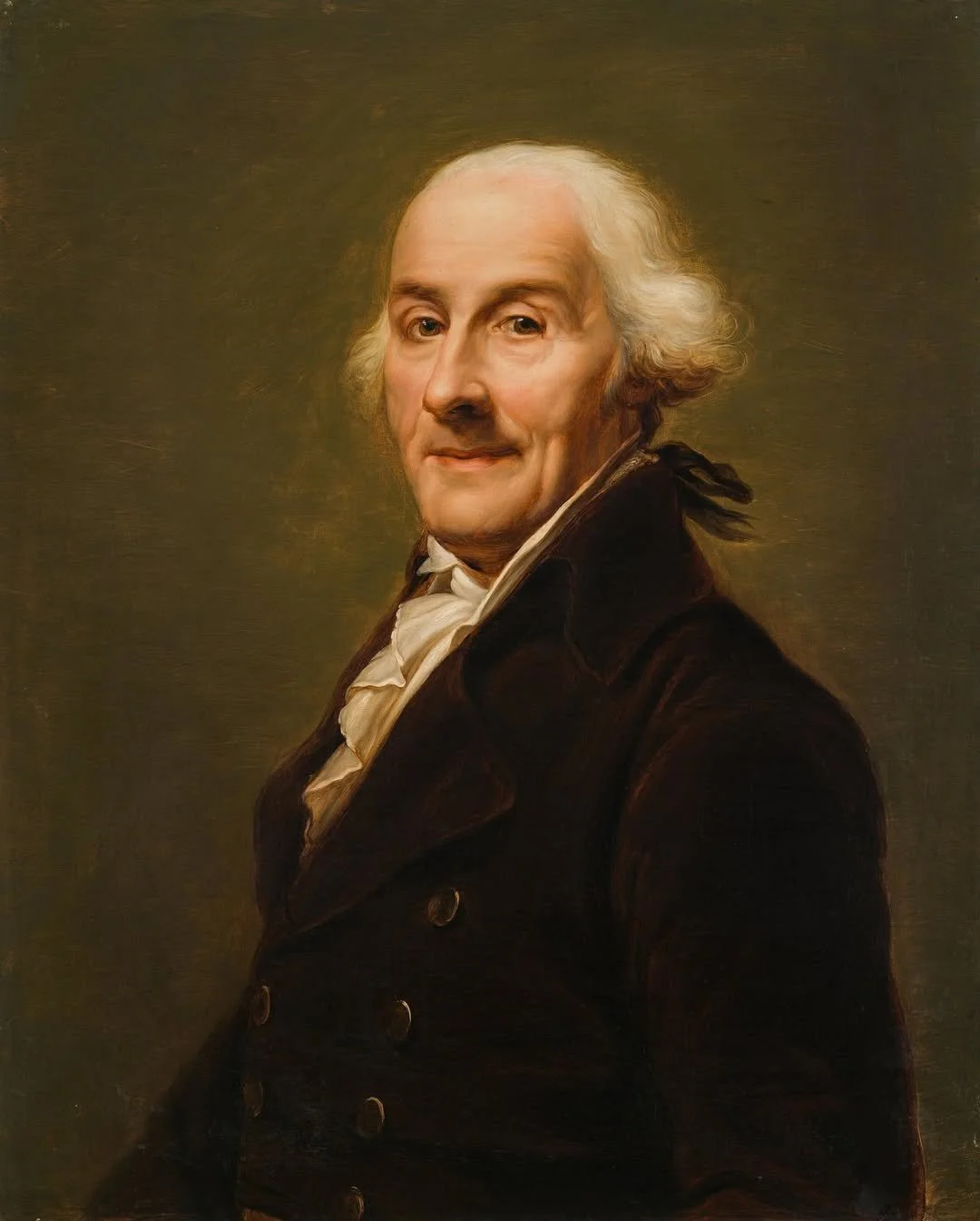
Da Ponte in Vienna (Johann Baptist Lampi, portrait "of a Gentleman," probably Da Ponte, 1790s)
One of the pleasures of getting ready to celebrate the 200th anniversary of opera in America is spending time with the biography and writings of Mozart’s great librettist, Lorenzo da Ponte. In the course of doing that, we have found a gem that we want to share with all Teatro Nuovo’s followers.
Da Ponte was a character Dickens or Manzoni could have invented in a novel, or Shaw in a play: charming and charismatic, impractical, always short of money, always running off with one girlfriend or another, always looking for adventure and work. He had a long life, really long for those days: he made it to 89, crazily active to the very end. The through-line of it all was a love for Italian poetry, which he studied, taught, promoted, and composed constantly.
His famous librettos for Mozart deserve all the praise they have had and then some. Whether adapting, improving, and augmenting earlier texts (Il Don Giovanni), translating Beaumarchais’ French into lapidary Italian verse (Le Nozze di Figaro), or inventing out of his own well-stocked imagination (Così Fan Tutte), he added something inimitable to the final product. Great as Mozart was, Mozart + Da Ponte is something beyond.
The poet was born in 1749 to Sephardic Jewish parents in the Republic of Venice, followed his father in opportunistic conversion to Catholicism, and got the benefits of a seminary education without absorbing any great amount of moral inhibition; his Venetian episode ended when he was convicted of living in a brothel and organizing its entertainment program.
After stints in various other Italian cities, Vienna, and London, Da Ponte emigrated to America in 1805. By 1825 he was teaching at what would become Columbia University, and his dream of showing Italian opera to the New World came true with the arrival of Manuel García and his troupe of singers. He collaborated with them on the production of Il Don Giovanni, making a new edition of his text and writing a short introduction–rather naively printed in Italian only, though he had the libretto itself translated into English by his son Luigi.
That essay is the gem mentioned above. As far as we can tell, it has never been reprinted, not even in the Italian collected edition of Da Ponte’s works, much less translated into English–a lack we hasten to remedy below.
The preface starts with a long complaint about the under-appreciated and underpaid lot of the librettist in Italy’s theaters, which is amusing in itself, but also informative for historians about an interesting episode in London, and for readers who care to know which other librettists earned Da Ponte’s admiration.
But when he gets around to Mozart he puts his finger on something quite new and startlingly prophetic: he has noticed that the three great operas they wrote together have stayed in the repertory beyond their sell-by date. Operas were not (then) expected to do this. Something new was happening: the artform had matured to the point where it was generating masterpieces so individual that they became permanently important, the way Homer or Shakespeare or Dante were permanently important. Opera was starting to produce “classics.”
How truly marvelous, then, must it seem that in this flux of tastes, Mozart’s three dramas should be practically the only ones no modern composer has been able to dethrone; the only ones that grow daily in prestige and esteem on every European stage; the only ones that seem to say in triumphal tones, WE ARE ETERNAL?
If only he had known! When he wrote this, Il Don Giovanni was 39 years old. “Modern” meant Rossini. Norma, Lucia, Traviata, Aida, Pagliacci, Bohème, Turandot and all the rest lay in the future. “How truly marvelous,” then, that “Mozart’s three dramas” should still hold their place two centuries on! What Da Ponte perceived was the earliest phase of a glorious period, when work after work would outlast its moment and transcend its vogue.
That period didn’t last forever; movies and other forms of expression eventually moved opera away from its central position. But what Da Ponte understood has profound meaning for opera-lovers today. While it was up and running, our artform produced more great material than any one of us can get to know in a lifetime. That means it will always be fresh, whether or not good new operas appear: as Da Ponte would have put it, opera is eternal. Lucky poet that he lived long enough to see it starting!
-Will Crutchfield
TO THE DEVOTEES OF DRAMA
LORENZO DA PONTE
If the impresarios of Italian theaters were less stingy and more perceptive; if they understood the necessity of a good libretto for an effective opera; if, instead of hiring whoever is vain enough or needy enough to gnaw at the public ear* with their paltry verses, they could first seek the good poets, and then honor them with good pay as other nations do (especially France)...if our composers would steadfastly refuse to dress the drivel of such fools with their melodies…if the Directors of Italian opera abroad** would select only the good ones (and we have a few of those ourselves); if the translations produced were not a pack of nonsense; if, finally, the originals were not mutilated, mangled, and adulterated at the whim of every singer, and were not disfigured with a charming embroidery of six or seven hundred misprints that remove even what little merit remains….then we would no longer see the melo-monstosities outnumbering the true melodramas on our stages, and the Nation that in tragedy, in comedy, in pastoral, and in every other poetic genre, can show itself in the arena without blushing, could then boldly step forward also in the field of drama, and not without glory.
In Vienna, Zeno, Metastasio, Calzabigi, and (for gracefulness of style) the Abbé Casti; in Dresden Migliavacca and Mazzolà; in Berlin Caramondani; and in St. Petersburg Coltellini–all these, because duly rewarded, gave glowing proof of what Italian ingenuity can do in this genre as well. These very dramas, however, even with marvelous music by the likes of Sarti, Buranelli, Piccini, Sacchini, Anfossi, Guglielmi, Paisiello, and other first-rate composers of the last century, are no longer performed in our times, just as the tragedies of the Greeks, the comedies of Machiavelli and his contemporaries, or the pastorals of Torquato Tasso and Giovanni Battista Guarini are no longer staged—not because they fail to remain models of true beauty, but because
“As the forest’s leaves change with the seasons,
the first-grown must fall.” [Horace, Ars Poetica]
Thus whatever depends upon taste must change as time goes by; and even if the dominant taste may not be the best, it nevertheless takes the place of the one that reigned before, until a new taste is born that drives it in turn from the throne. How truly marvelous, then, must it seem that in this flux of tastes, Mozart’s three dramas*** should be practically the only ones no modern composer has been able to dethrone; the only ones that grow daily in prestige and esteem on every European stage; the only ones that seem to say in triumphal tones, WE ARE ETERNAL?
The words of these dramas were written by me. I most willingly cede to that immortal Genius all the glory due him for such wondrous creations; let me be permitted just to hope that some faint ray of this glory might fall upon me, for having provided him the vehicles for such enduring treasures, with my fortunate verses.
* Da Ponte’s Italian text uses the verb “rosicare,” to gnaw—an untranslatable pun on the name of Paolo Rosich, a basso buffo who sometimes wrote libretti–including those composed by Manuel García for New York.
**Author’s footnote: In 1796 I took to London and offered to the Direction of the Italian theater my Don Giovanni. At that time the acting Managers were Mr. Michael Kelly and Signor Vincenzo Federici. These two most learned Personages gave the preference instead to the Don Giovanni of Gazzaniga!!! It was almost enough to make the English Gentlemen tear down the theater!!! This honorable bit of anecdotage did not find a place in the Memoirs of the forgetful Mr. Kelly!
***Author’s footnote: Le Nozze di Figaro, Il Don Giovanni, e La Scola degli Amanti. [The third of these is the opera we know today as Così Fan Tutte. - Ed.]
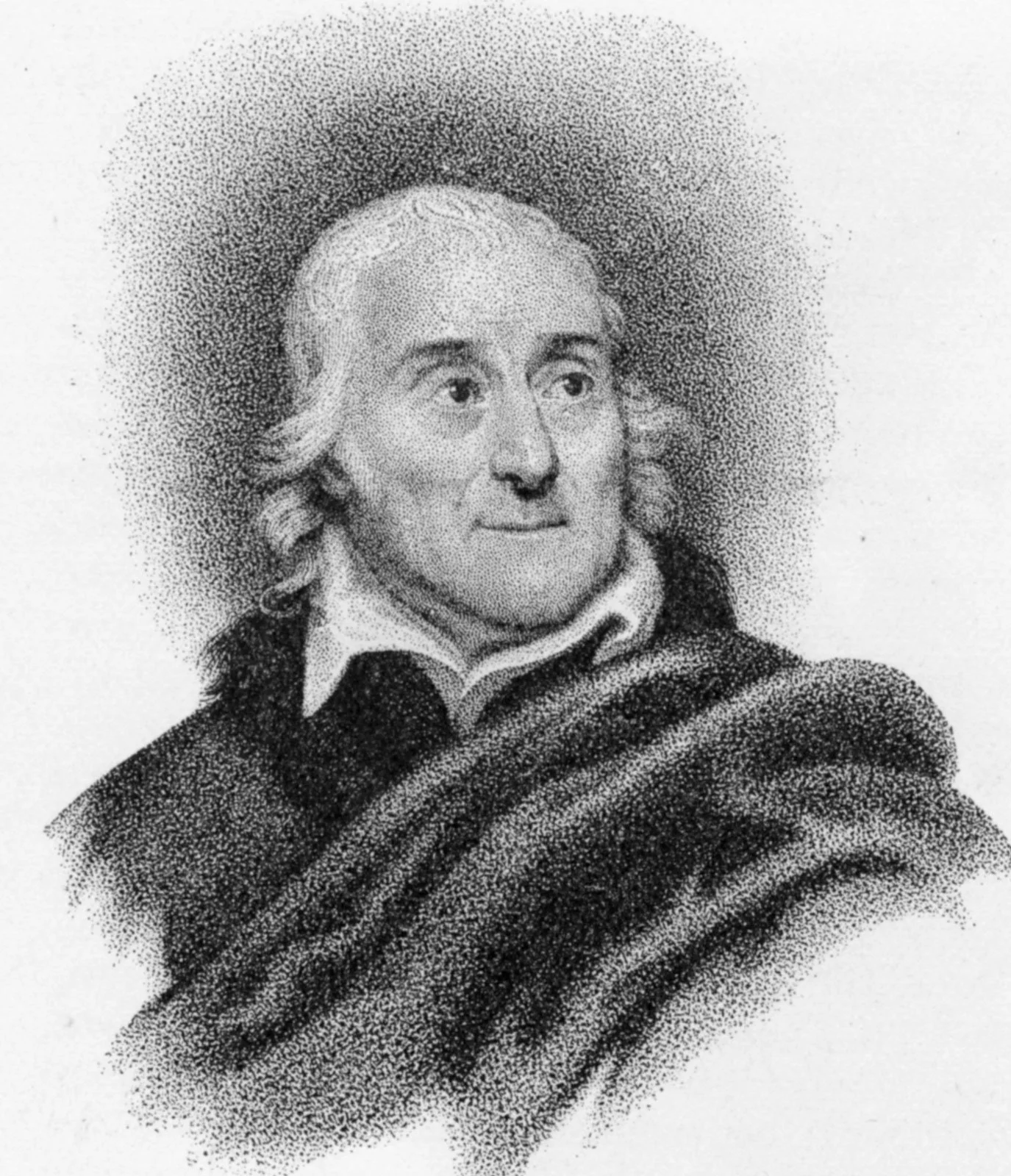
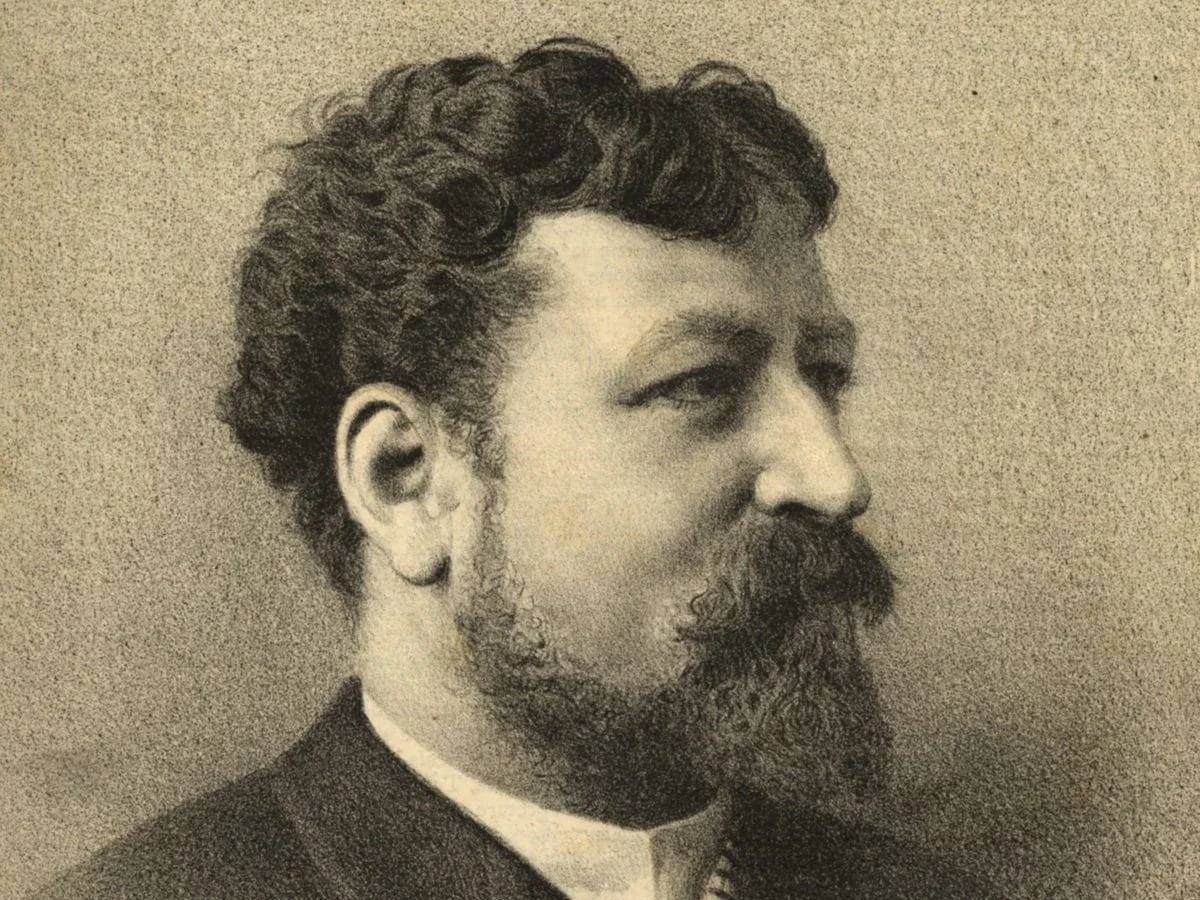
Da Ponte in New York, unknown lithographer, 1820s
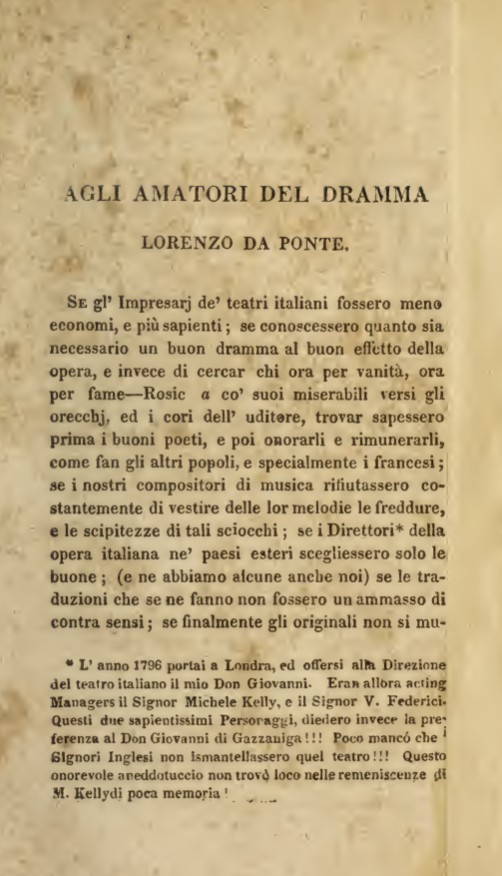
Opening of Da Ponte's essay, "Nova-Jorca" 1826